留言
如果您对我们的产品感兴趣并想了解更多详情,请在此留言,我们会尽快回复您。


I. Project Overview
Project Background
As the global energy structure accelerates its transition toward green and low-carbon development, Malaysia continues to promote renewable energy development and actively expand solar power applications. As an important part of clean energy construction, ground-mounted PV projects are gradually extending into complex terrain areas, placing higher requirements on the terrain adaptability, foundation construction efficiency, and environmental friendliness of solar module mounting systems.
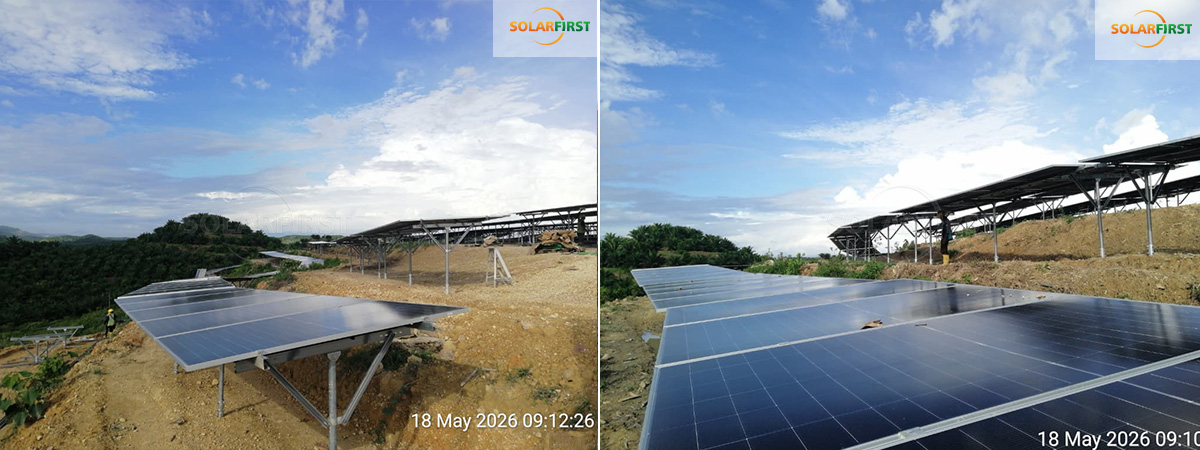
Solar First Group participated in the construction of the 21.47 MWp ground-mounted solar module mounting system project in Malaysia. The project adopts a carbon steel ground-mounted solar module mounting system and helical pile foundations. In the face of complex construction conditions such as undulating mountainous terrain, hard soil, and subsurface gravel, the project effectively adapts to different slopes and terrain variations through customized mounting system design and differentiated array layout. While ensuring the installation adaptability of the solar module mounting system, it minimizes on-site earthwork, providing an efficient and flexible solution for PV project construction in complex mountainous environments.
Project Requirements
The site has complex terrain, with a maximum slope of 20°, and some areas are distributed in stepped forms. The site soil is relatively hard and contains subsurface gravel. Conventional site leveling and foundation construction methods tend to increase earthwork volume and construction difficulty.
The core requirement of the project is to reasonably configure the solar module mounting system and foundation system while adapting to complex mountainous terrain, reduce large-scale site leveling and earthwork excavation, minimize disturbance to the original terrain and natural environment, and balance the flexibility of mounting system installation with on-site construction feasibility.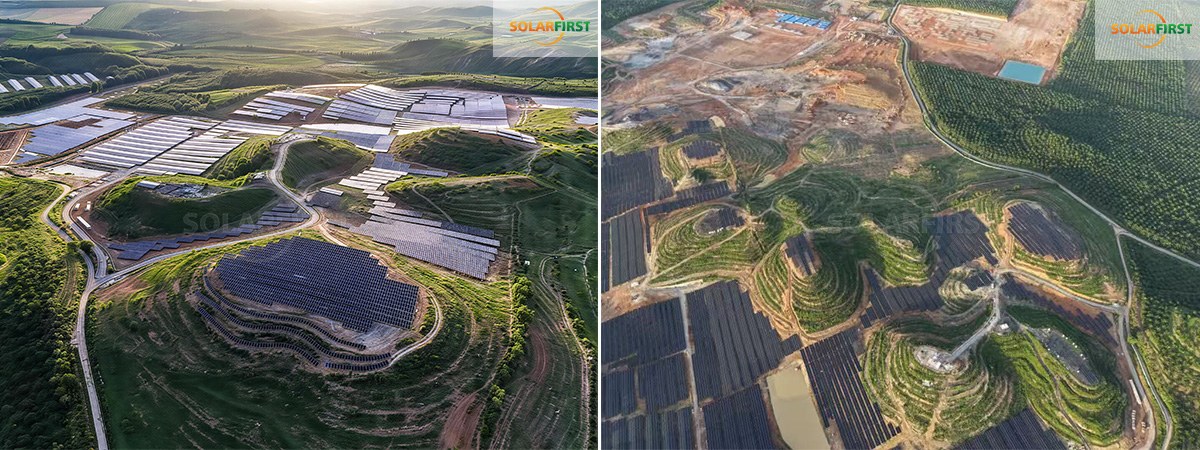
II. Project Challenges
1. Large terrain slope variations make uniform layout difficult
The site has a maximum slope of 20°, with gentle slopes, steep slopes, and stepped slopes alternating across the area. Installation elevations and array layout conditions differ significantly from one zone to another. If a uniform elevation and standardized array were adopted, on-site adaptability would be insufficient, increasing local adjustment and site treatment workloads.
2. Hard soil and subsurface gravel increase foundation construction difficulty
The site soil is relatively hard and contains subsurface gravel. Conventional foundation types are constrained in terms of hole drilling, excavation, and construction efficiency. The foundation solution needs to match the site geological conditions and reduce reliance on extensive excavation and concrete construction.
3. High requirements for earthwork control and ecological disturbance mitigation
The mountainous terrain is undulating. Large-scale slope cutting, filling, and site leveling would involve considerable earthwork and cause significant disturbance to the original landform and natural environment. The project therefore imposes strict constraints on reducing earthwork and protecting the original ecological environment.
III. Solutions
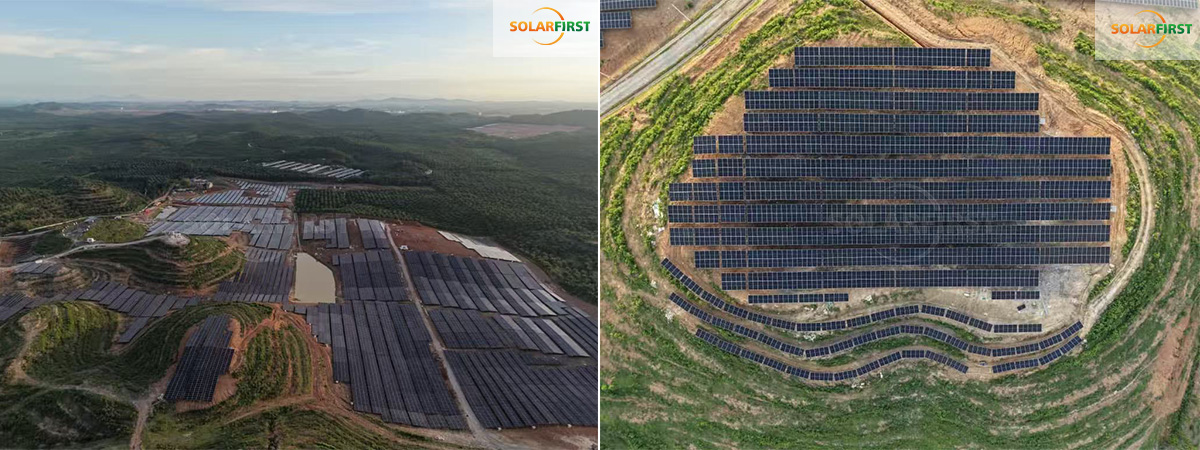
In response to the site terrain and geological conditions, Solar First Group adopts a combined solution of an adjustable ground-mounted solar module mounting system, helical pile foundations, and a zoned array layout, replacing large-scale site leveling with slope-adaptive layout and local adjustments.
1. Adjustable solar module mounting system and 2P/1P zoned layout
The post height and installation angle of the solar module mounting system are adjusted by slope zone so that the array follows the terrain. In gentle and steep slope areas, a vertical 2P configuration is adopted to improve slope utilization efficiency; on the step surfaces of stepped slopes, a 1P configuration is adopted to facilitate local avoidance and flexible layout. The combination of 2P and 1P enables differentiated layout for different terrain units.
2. Helical pile foundations and construction adaptation in hard soil and gravel sections
The ground-mounted solar module mounting system uses helical pile point foundations, reducing extensive concrete foundation construction. Before construction, test piles and site geological conditions are used to determine the screw-in process. In hard soil and gravel areas, measures such as adjusting pile locations to avoid obstacles, local pre-drilling, or adjusting pile positions are adopted to ensure foundation construction feasibility.
3. Slope-adaptive layout and local adjustments to control earthwork volume
The slope-adaptive layout of the solar module mounting system, zoned arrays, and point foundations reduce overall slope cutting, filling, and site leveling. Local adjustments are made only in areas with insufficient installation conditions, together with measures such as topsoil protection and drainage arrangement, to reduce construction disturbance to the original landform and natural environment.
IV. Project Value
The 21.47 MWp solar module mounting system project for mountainous terrain in Malaysia fully demonstrates Solar First Group’s capability to provide customized solar module mounting system solutions for complex terrain.
Facing multiple challenges such as slopes of up to 20°, hard soil, subsurface gravel, and stepped slope surfaces, the project combined helical pile foundations, adjustable solar module mounting system design, and differentiated vertical 2P and 1P layouts, achieving effective integration of the mounting system solution with on-site terrain conditions.
With core advantages of flexible adaptation to complex terrain, reduced earthwork, and lower disturbance to the natural environment, the solution reduces reliance on large-scale site leveling and provides a more flexible construction approach for mountainous PV projects.
Solar First Group will continue to develop solar module mounting system technologies and system solutions. With a site-specific design philosophy and flexible product configurations, it will facilitate the efficient construction of global PV projects and promote the coordinated development of green energy development and natural environmental protection.

 en
 fr
 de
 zh-CN
 ru
 es
 pt
 ja
 ko
 ar